
Revenue Cycle Challenges
More Denials. More Audits. Not by Accident.
Payers have invested heavily in AI-driven claim review that denies and audits at scale, while many health systems still work appeals by hand. That gap favors the payer.
The Numbers Keep Climbing
Recently, the numbers only move one direction
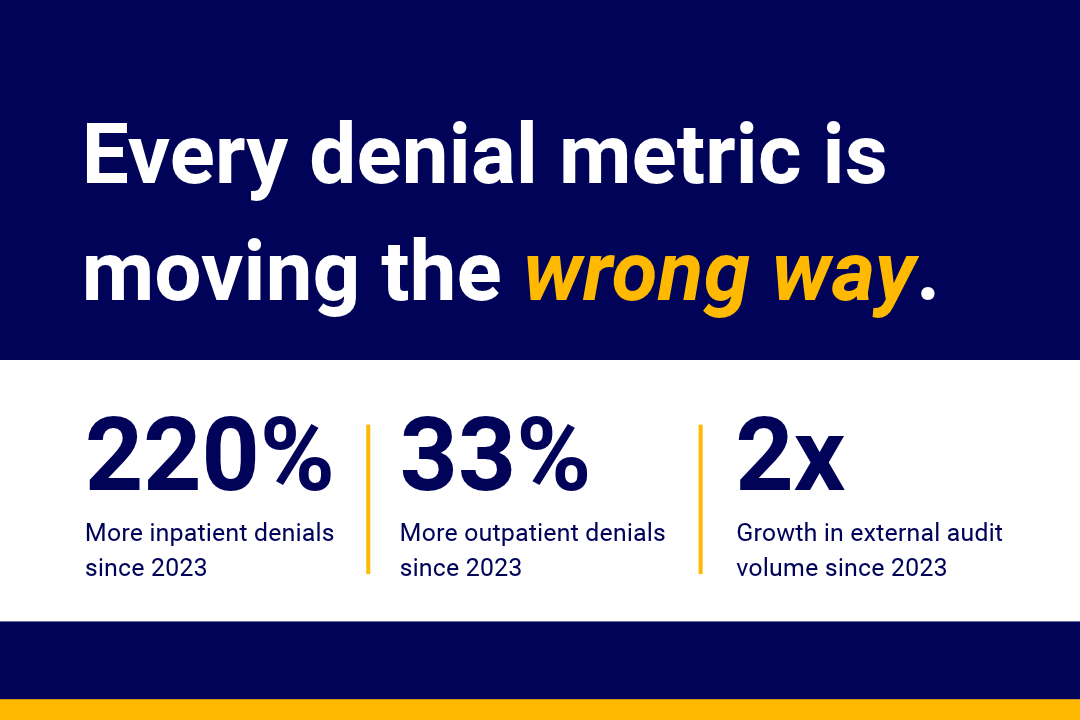
Inpatient Denials
220%
Rise in inpatient denials over three years. The average denied inpatient claim is now $10,000.
Outpatient Denials
33%
Increase in hospital outpatient denials. The average denied outpatient claim is now $825.
External Payer Audits
2x
External audit volume more than doubled from 2023 to 2024.

What This Means for Your Revenue
The Scrutiny Didn’t Go Away. It Moved Downstream.
Payers are reducing prior authorizations and reviewing more claims after care is delivered, when all that’s left is to defend it. With AI and automation, they can delay and deny claims in volumes no manual workflow can keep pace with. Workloads grow, cash slows, and clinicians get pulled away from patients.
The good news? The right approach changes the outcome. Strengthen documentation up front, track denials by payer, and match payer speed and scale with technology of your own. With clinical, legal, and technical expertise working together, your team can recover more revenue, so your organization can stay focused on patient care.
Rising Denials, Explained
Are payers using AI to deny claims?
Yes, many are. Payers use machine learning to flag claims for denials, DRG downgrades, and audits in volumes manual review teams can’t keep pace with. For health systems that still rely on manual appeal workflows, that gap keeps growing. It’s why more revenue cycle teams are adding AI to their own denials management.
Which denials are growing fastest?
Inpatient denials, according to HFMA. They’re driven by DRG downgrades, medical necessity disputes, and inpatient-versus-observation level-of-care challenges. Outpatient denials and external payer audits, including post-payment medical record reviews, are also climbing.
What do rising denials really cost health systems?
More than most teams can see. Denials delay or eliminate payment for care already delivered, which puts pressure on margins. Underpaid and downgraded claims often close as zero-balance accounts and drop out of work queues entirely, so much of the revenue at risk never reaches your team’s attention.
Why are hospital claim denials rising so quickly?
Several factors are at work. Payers have invested heavily in automated claim review, moving scrutiny from before care to after it. Medicare Advantage growth adds stricter review requirements. And documentation gaps make claims easier to deny. Together, these factors have created pressure that’s unlikely to ease anytime soon.
Which departments and claim types are most exposed?
No department is fully protected, but inpatient services carry the highest financial risk. DRG downgrades and sepsis claims are especially contested. Emergency departments face more level-of-care disputes, and high-dollar service lines such as oncology, cardiology, and surgery are frequent targets for post-payment review. Outpatient coding and technical denials add volume, even when individual claim amounts are lower.
How can hospitals respond to the denial trend?
Start with visibility: track denials and audits by payer, claim type, and denial reason. Strengthen documentation before claims go out, especially for high-risk inpatient stays. Then match payer speed with your own. Many health systems now pair clinical and legal expertise with AI to appeal faster and more consistently. And don’t overlook denials you’ve already written off.
See how one health system recovered $1M+ from denials it had never appealed.
Let’s Recover More Together
Tell us about your organization. We’ll show you what’s possible.